_edited.jpg)


Breaking Bread and Barriers: Intergenerational Bread Therapy with Seniors and Teenagers
On August 16, 2025, we proudly hosted our inaugural official bread (art) therapy event at the BreadHaus, our charming traditional workshop/community space located in the town of Kettle Falls, Washington. Bread Therapy was pioneered by Bulgarian anthropologist Dr. Nadezhada Savova, founder of the global Bread Houses Network as a means to break barriers across gender, age, ethnicity and religion through collective bread making and story-telling on a flour canvas. The BreadHaus in Kettle Falls is the first Bread House in the US licensed to utilize the Bread Houses Network bread therapy* methods which provide mindful, hands-on experience to support stress reduction, emotional healing and social bonding through community bread making events. This type of bread therapy has been used in Europe in settings ranging from hospitals to community centers, supporting people with disabilities, trauma survivors, refugees and intergenerational groups.
*bread therapy is not a clinical therapy but rather a wellness program
For our intergenerational bread therapy event our charming volunteer Katrina Robison had recruited 10 brave souls from the Inchelium Community Church, including 5 seniors and 5 teenagers. Of the 10 participants, we had one teenage male participant and one senior gentleman,.
On the chalkboard in our workshop, we detailed the "sequence of events" to let our guests know what to anticipate over the next two hours. After instructing everyone to wear their white "Share The Loaf" aprons and sit wherever they liked, we found all the teenagers on one side and the seniors on the other. We began the workshop by asking everyone around the table to introduce themselves and share their secret superpower or something that made them unique. This engaging activity offered an insightful first impression of each participant.
The next step was to ask the group to form pairs, each consisting of one teenager and one senior, in preparation for the team dough-kneading activity. At each end of the table, there was a flour sifter and a vase with wheat stalks. Participants were instructed to sift a thin layer of flour onto the workspace in front of them with the purpose of creating a canvas for our next step: drawing in flour to tell a story.
Our predetermined theme was "Independence/Purpose," a topic that both our energetic teens and wise seniors could truly connect with..

After the tables were dusted with flour, we unveiled the theme and allowed participants to relax to Sissel's soothing version of "Slow Down." The goal was to encourage introspection and self-connection. We instructed them to use wheat stalks as drawing tools to create images inspired by their thoughts regarding the theme of Independence/Purpose, emphasizing that the quality of their artwork didn't matter. After a few minutes of contemplation, everyone eagerly began filling the space before them with lines and images.
We got our first participant (one of the teenagers) started with the words "once upon a time..." Her illustrations featured a boat, fish, the ocean, and a fisherman—images that had surfaced in her mind during our "slow down" session. Katrina, our fantastic volunteer, was prepared with pen and paper to document the story, while Sibyl served as the facilitator, encouraging our storytellers with questions. We explained that, as we went around the table, each individual would get yo explain their drawings and then link it to the storyteller who preceded them in order to build a collective story. This opened up conversation as participants offered their suggestions for the progression of the story and asked questions of the current story teller regarding their drawings, opinions and emotions. (One of the teenagers, when asked what she liked most about the workshop in an anonymous questionnaire at the end of the workshop, wrote "I liked sharing my story and listening to other's"). There was also much laughter during the story telling phase.

Many of our story elements were metaphors and as we went around the table the story took some interesting turns. We learned of beautiful plants which live independently in areas where few people get to enjoy their beauty, we learned that the fisherman actually had a brother and what looked like a path in the woods was actually a river. One of our seniors, who had recently lost his wife, created a flour illustration of a man hunched over and shared his deeply moving story of his recent loss and his attempts, with the Lord's help, to lift himself up again. Initially skeptical about our activity, he apparently spoke to his church congregation about our bread therapy event (as we later discovered), describing it as "the therapy I didn't know I needed."
After the story telling came to a conclusion, it was time for a break. During this period, our participants strolled around the table, took photos of each other's painted flour canvases, and conversations between our two groups continued.
Flour drawings are a representation of the moments in our lives: ever so precious but also ever so fleeting.
With this understanding we cleared our flour canvas to prepare for the next stage of our event.
Every table was arranged with the essential ingredients for preparing bread dough, along with a small chalkboard that showed the recipe. Each team of seniors and teenagers received a bowl and was responsible for measuring the dry ingredients before adding water to combine them. We talked about the different ingredients, making connections to aspects of our lives, and encouraged participants to select an ingredient they felt represented them, asking them to explain their selection
.
The next part required some serious teamwork! Each team would knead the dough together in one bowl with each participant using one hand for the task.
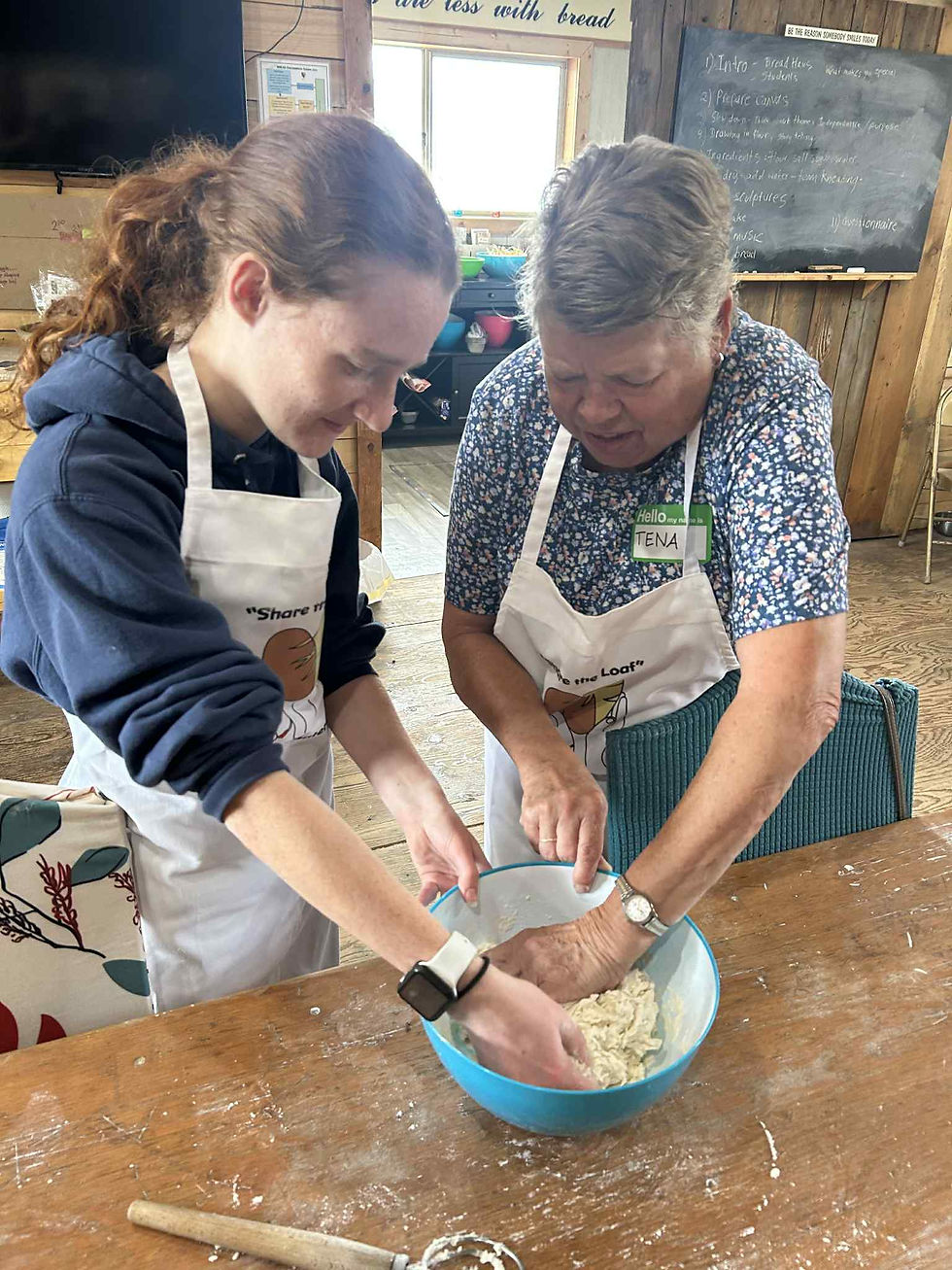
It was delightful to witness the pairs being engaged in conversation with each other and "kneading" each other to prepare the dough for their future bread sculptures. After approximately 10 minutes of kneading, each team divided their dough in half with their partner.
The subsequent task involved shaping one or two bread sculptures inspired by the initial flour drawings which were then baked in our trusty Pico Plus BreadHaus oven.

While the bread sculptures were baking and filling the BreadHaus with the warm and comforting scent of fresh bread, we prepared for our upcoming kitchen music by handing out wooden spoons, rice or bean filled glass jars and any noise/rhythm implements we could find on the premises!
Katrina and Sibyl had reworked the community flour story to fit the melody of John Lennon's song "Imagine" which was played karaoke style over loud speakers They invited all the "storytellers" to participate, either by singing along and/or by adding rhythm to the "kitchen music," to experience the oy of making music together. It was a noisy but uplifting collective experience for all!
Once the bread sculptures were taken out of the oven, Sibyl talked about the global tradition of sharing bread. She urged everyone to break pieces from their bread sculptures and share them with one another, symbolizing friendship and community as the bread therapy activity came to an end.
This first official bread therapy event not only celebrated the art of bread baking but also highlighted the importance of community, creativity, and self-care in our lives.
If you would like to learn more about how our tailored bread therapy wellness workshop can benefit your specific group of people, please contact us at 619-990-5761 (text) or e-mail us at BreadEncounters@gmail.com.


Comments